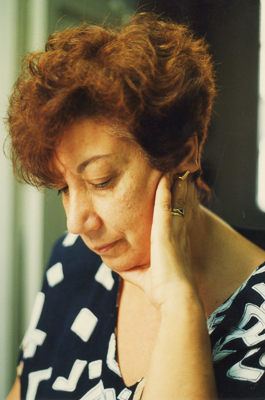
Throughout her career, the work of Susana Romero-Alayón was reviewed by art critics from Argentina, Paraguay, and other countries. We reproduce here the complete texts, with each author's attribution, as they were originally published.
Susana Romero, Pinturas 1963–1991
Ticio Escobar — Museo Paraguayo de Arte Contemporáneo
Susana Romero's imagery begins to take shape through drawing: through a world of lines and broad white spaces. Her first figures are already summoned by a strong expressive need bound to the fate of man and to communication with his surroundings: the broad, spare strokes, gathered into nervous points, contract and tense, forced to speak of hardship, of intimate anguish, or the pure solitude of the empty page and the essentialist poetics of her later work.
When Susana Romero decides to paint these solitary, frightened figures — these stylized, still hesitant forms — she begins a process of adjustment that draws on volume and color, the play of brushstrokes, light and transparency. But this appeal to painterly means does not yet abandon the underlying weave of drawing, which remains silently sustaining the dense weight of the brush, and which always reappears whenever the painting recedes to reveal its bare, clean framework — the silent space that both supports it and presses upon it.
Alongside this formal adjustment of her imagery, Susana Romero begins to deepen her content and meanings. The simple expressionism of her early drawings gradually opens onto a particular figuration with a lyrical slant, at times touched by the magical, but always closer to the elusive play of metaphor than to wonder before fiction or ease before the absurd. Her symbology, which steadily gains consistency, is built from a number of recurring signs that foreshadow later reflections on space and concerns over a nature that both threatens man and is, in the end, always threatened by him in turn. The human figure takes part in a natural realm that it also, in part, confronts: animals, dragonflies and bees become ciphers of another reality and, against the backdrop of the landscape, introduce a struggle between the strong portraits and their small, fleeting presences.
In this process of consolidating forms and concepts, techniques and content, the analytical currents of the late seventies supply new arguments and expressive resources. More deliberate work on pictorial space allows Susana Romero to introduce approaches to the figure/ground and reality/fiction relationship: windows suspended in the void, transparent planes, glass walls and boxes establish an ambiguous realm in which the inside/outside opposition can be overcome through a simultaneous reading of both terms. Her reuse of Renaissance portraits lets her underscore a certain meta-linguistic character in the work: the human figures do not refer directly to real people but through the mediation of prior images; they are signs of signs.
Susana Romero's work is essentially figurative: representation was always its axis, one she remained faithful to through different positions. Yet the flower paintings form a constant reserve of chromatic, technical and expressive research: chrysanthemums and sunflowers, the vague invented flowers, are stains and are textures, transparencies, densities. They are serene bursts, tensed harmonies.
Susana Romero's final stage seeks to recapitulate and draw conclusions from her different stylistic and technical moments. The large polyptychs that appear at this point are crossed by broad, confident brushstrokes. These worlds begin with landscape; a landscape purged of anecdote and incident, reduced to mere ground of stormy grasslands, to a pure sky of dark light. Insects arrive next: beetles, butterflies and dragonflies of light flight, ephemeral and trembling lives. Then come the snails, hermetic forms closed upon themselves, pointing to pure interiority or to mere absence. Man enters the scene not as though it were a place prepared for him, but as though it were a place of passage, a terrain forever strange through which he wanders, disoriented.
As a corollary, the original axis of Susana Romero's poetics reappears, defined and refined, centered on the precarious condition of man, always situated between nature and symbol, between finitude and project. In the end, the passage between real space and dreamed terrain is only another illusion; a paradox that can only be resolved by embracing the fiction that sustains it, or by understanding that every landscape trodden by man becomes bound up in his fate, turned into a tense arena of encounters and missed encounters, an atmosphere of representations: a stage for impossible fantasies.
Ticio Escobar — Catalog text for "Susana Romero, Pinturas 1963-1991", Museo Paraguayo de Arte Contemporáneo
Lights, Crosses and Other Shapes
Ticio Escobar — September 2001
Currently showing at the Centro Cultural Borges in Buenos Aires can be found a collection of paintings and intervened photographs by Susana Romero, an Argentinian artist strongly connected to Paraguay's visual and cultural practices. Susana's work obsessively circles around certain representations, figures and images that come from archaic configurations and ritual gestures that inhabit our consciousness and fill it with different voices and silences. The subject of Kuruzú Jeguá, now exhibited in Buenos Aires, constitutes one of those moments. The celebrations of Kuruzú Jeguá, literally "the ornamented cross", is a rich phenomenon and part of an itinerary that begins with guarani and colonial traditions and unfolds until reaching our present time. Much like great part of the half-breed Paraguayan tradition of Kuruzú Jeguá it has a double origin. Part of the guarani altar, adorned with feathers, crosses and wood carved figures, culturally mixes with the figures of the originally Spanish Fiesta de las Cruces de Mayo (Crosses of May Festivity), where the tradition of honouring the cross on a stage of paper flowers and currency bills still continues and serves as an occasion for collective prayer.
The way in which Susana portrays the forms of Kuruzú Jeguá, express the amazement, and sometimes despair, of someone who faces a world arisen at the frontiers of shared memory, and foreign remembrance. The many years the artist has lived in that country have involved her in parallel spaces that secretly hold her mixed history. They are distant spaces that even if materialized in our own neighborhood remain strange, not only to the one arriving from the outside, but for those of us who live here without too much understanding of what takes place on the margins of global structures.
To name this other world, to represent it's impure beauty of half-breed altars, to cross the forbidden frontier that separates the self from the other, the work of Susana Romero has had to travel a different path in it's lines and shapes, to reinvent it's shades and colours, to quicken the meaning of forms established by western aesthetics, to subdue the impulse of these figures, too impetuous to tell these truths with any serenity. Therefore, the fleeting scene of the Kuruzú Jeguá, it's clear images and bleak frame, is shown in distressed and uncertain shapes and contours, in the midst of foggy lights and through ambiguous new colours, trying to capture the silence that shelters the canes of castilla and the peanut rosaries, and that drag prayers and songs without breaking them. Now the colours fade out and light up, banished or summoned by furtive arguments and shadows and candle light (and now neon light), unknown to her brushes because of tremors and vertigo, because of barely fathomed enigmas.
And in this way the Kuruzú Jeguá lights up and darkens from the background and lights up from within, from beyond the sacred place, to tell the backdrop of the parallel scene. Again, transformed and grazed by the secret of the ritual circle, the image of Susana Romero travels a path in which the encounter with the "other" makes her work return strengthened and invigorated in the broadest artistic expression of her great paintings and her series of intervened photographs, where she tells us of her intimate Kuruzú Jeguá, recreating a symbol that is ours and she helps turn universal.
Ticio Escobar, September 2001
The Whims of Memory
Ticio Escobar — Hoy Arte Hoy, Year VIII, No. 14 (2007)
It is through ritual that men and women concentrate the collective experience to its upmost and poetically express what they can explain through disciplined concepts: the dark reasons for desire, the enigma of fundament and origin, the arbitrary paths of memory. Covered with masks the participants of the celebration seize the face of gods and ghosts to re-imagine time and exorcise death.
Susana Romero builds a scene within that scene and represents that confusing and lucid, mythical and bright world, in which the ancient ceremony of the ancestors takes place or where the impure beauty of halfbreed altars and hybrid ceremonies rises. Susana obsessively circles around certain representations, figures and images that come from archaic configurations and ritual gestures that inhabit our consciousness and fill it with different voices and silences.
The anthropological, biological and metaphysical relationships as well as the cosmogony of men, intertwined to our planet and universe, emanate from the iconic reading of certain symbols, establishing a personal conception of the origin of life which has a mystical quality that makes reference to the original inhabitants of the lands and waters. A universe of arguments containing images underlined by spiritual visions that reach a, perhaps, primarily pictorial state, where the emotional pulse we identify in this new undertaking flourishes.
The chromatic values are almost meticulously over studied, with a profound use of cold and warm lighting, appearing in shades of blue and red, distributed alternately at its core or its edges, the palette is nearly monochrome, admitting scarce coloristic complementarity. Here one can sense a completely aquatic or earthly atmosphere, of a visually invasive luminosity as in the composition of "El rescate" (The rescue), deliberately stressed by a luminous plane of concave and uterine analogy where the artist's own linear archaeologic and zoomorph symbols are randomly arranged. An image that can also unfold into the reminiscence of trees encapsulating groups, animals and pictograms. Graffitted upon stones, some of these symbols, such as the spiral, find refuge in the paintings: several times repeated, the concentric circle states the phenomenons of life until proclaiming cosmic infinity.
However, one must take notice of the constant presence of fish and aquatic elements that spread over most of Susana Romero's work. The element of water is presented as the evolutionary nexus between the minimal expression of life, the single cell, and between the braquial fish and the pulmonary man; as the essential cohesive agent in the evolutionary process of life, and that which signifies the liquid and gaseous metamorphosis. The trinity of beings represented schematically, suggestively reinforce the archaic origins, wrapped in tempestuous shades of blue or stroked by earthly colours.
This painting, which develops and expands the veiled memories of origins, narrates the genetic traces of an ocean of doubts, guiding the artist's encounter with her ancestors, perhaps in search of paradise and it's tree of life. Nobody leaves the circle of the ritual unaffected. Grazed by the secret of deep otherness and disturbed by the risk of uttering its name, Susana Romero's image returns grown/matured and different.
Ticio Escobar, Art critic
Susana Romero — Centro Cultural Borges
Rafael Squirru — Arte al día
When Susana Romero decides to carry out an important work of art, she accomplishes it. As are, her fish and her Kuruzú Yeguá – adorned cross –, ritual of the popular mysticism of Paraguay and the northern argentine coast. We know that for some time now this argentine, who adopted the paraguayan land for quite some years, has been producing important research which captures the view of the universe which that marvelous region holds, that captivates anyone who has stepped foot in it.
In acrylic on canvas, such as in "El árbol de la vida" (The tree of life), Susana Romero shows us human figures and fish on a blue backdrop which could easily be aquatic. In the Kuruzú Yeguá, from the underlying darkness a sort of hymn rises to orange tinted regions towards which the human figures converge to dissolve in the superior area. Also "El Rescate" (The rescue) alternates darkness with orange tints in the center towards where humans, fish and some rider converge.
Everything is bathed by the poetic force of this creator who has known to explore and reveal the most intimate secrets of that magical region. Susana Romero, who is featured in important museums, of both Paraguay and Argentina, has also fulfilled an outstanding teaching job when she took on the direction of the Paraguayan Museum of Contemporary Art's visual arts workshop.
Those who know Susana Romero will appreciate the authenticity of her paintings, which emanate from the authenticity of her being, an incorruptible spirit put to the service of the highest claims of artistic creation.
Rafael Squirru — Arte al día, monthly newspaper of cultural information
About the Artwork of Susana Romero-Alayón
Ilona Selmeczi, journalist and art critic — argentinauniversal.com
Susana Romero-Alayón has exhibited her art in different parts of the world at renown galleries, always loyal to a personal way of laborious work, totally committed to her motivations, the sinchretic myths in general and in particular, the mythical history of the American natives, putting emphasis specially in the culture of Indians of the Andes region, from the Anassasi to the Mapuche, also considering all the other Latin American original tribes. Actually, Susana Romero-Alayon uses the imaginary of hieroglyphs and petroglyphs and introduces them into framed boxes, which she calls "Archaic Signals" together with votive offerings which she has collected along her life of investigation, creating a combination between metal, paper and acrylic, rebuilding dreams and wishes of the forefathers of America. Precisely Karl Jung refers to primitive myths and the modern man, expressing that we are close to rediscover the ancient history of humanity in all it's significance, thanks to the symbolic images and the mythical history that has survived.
Through the knowledge of the first cultures of the world we will be able to recognize ourselves and our way in life. The signals left, are archetypal landmarks of humanity and also reiterative messages of the collective as well as the individual memory, a network which enables us to go through history and perceive the notable parallelism between all messages, conforming an immense universal message. This is the road that Susana Romero-Alayón has transited through her art work about the rites and myths in Paraguay. Like a contemporary shaman she makes use of the revelations she has in dreams and introduces them into her work, in order to combine them with the testimonies left by archaic cultures and giving new life to apparently hidden messages which have been present in history, waiting for us to discover them. In this path, Susana Romero-Alayón rediscovers her own interior world and merges with the foresights of those historic signals, transcending times on behalf of her art.
In this way the artist weaves her own spinning and tells us that "it would be very extensive to enumerate the literary origin that have given me clues to follow my intuition, I have been searching about this matter since I was a child, I presume. When I started to glimpse the magical world of rites (found in Paraguay) and related to the invocations of men, I started to read about this themes [...]. After a close experience with those rituals I started to transmit formally into my art works, my own perceptions about nature, the man, the woman, the idea of the snail as a symbol similar to the spiral and the universe, which all together form part of the sacral geometry. At this point I simply gave a step forward, to try to represent the untouchable of certain mystical and popular manifestations, i.e. like the Kuruzú Jeguá and the Kambá Ra Angá, which I experienced during the period of time I lived in Paraguay, all expressions that can be found in other forms in all the American cultures."
Ilona Selmeczi, journalist and art critic
Susana Romero
Sarah Guerra — Argentine Association of Art Critics (AACA) / International Association of Art Critics (AICA)
Susana Romero's current works show the complexity of a style that grows with production. Her works signed from the start by her remarkable use of pictorial mediums were inscribed within an expressionism where the human figure prevailed and a landscape projected towards the cosmos was in a constant dynamic relation represented by the strength of her brush stroke and her intensity of colour. At a later stage she incorporates the imagery of the guaraní region, delving into myth and rites of this culture and transposes her own signs and symbols into the paintings, Kuruzú jeguá, Kambá-ra-angá and especially in the installations where she recreates the deep feeling of that cosmovision.
Another response to the incessant question that Susana Romero poses in the face of artistic creation, is presented in her series of Cajas (boxes) and objects. Even though remaining faithful to her recurring images of indigenous paraguayan culture, she now also admits symbols of different origins, like the waste products of a society of industrial consumption or the objects found by chance which coexist in the persistent expressions of popular culture.
In another series of boxes she takes a risk with acrylics by using the changing transparencies that this material allows, incorporating dry stems and flowers frozen without alteration in their natural evolution. In these new works, Romero works on handcrafted paper where she pours slight hints of reality; text fragments, inscriptions which evoke seals of unknown messages, delicate strokes, stains of diluted colors and still visions of Kuruzú.
In the series of drawings and intervened photographs Susana celebrates new unstable spaces, charged with sense/meaning. She is an artist who is aware of her circumstance and her time. She expresses herself freely through a language enriched by new media such as photography. Procedure through which she pours interior states in natural forms, landscapes inhabited by loved ones, present in all her oeuvre, associations of memories, dreams and premonitions bathed in a subjective light of pure spirituality.
Sarah Guerra, Argentine Association of Art Critics (AACA)
Singular Figuration in Susana Romero's Exhibition
Susana Pérez Tort — El Norte Cultural, June 30, 2002
An exhibition by the visual artist Susana Romero will arrive in San Nicolás, at Astul Espacio de Arte. With a long and well-known career in our country as well as in Paraguay, where she lived for 20 years and produced much of her work, this artist and her poetics confront us with the monumental range of art that allows its creator to give shape to her most intimate convictions. Here we witness the poetics of ritual, myth, and nature; the communion of an artist with the land: the interior of our own country and Paraguayan soil.
Susana Romero's singular figuration is positioned midway between that accessible, visible, exterior world, and that interior, abstract one. Romero moves between the objectual and the conceptual, between what is recognized and validated in the real world — the fish, the snail, the landscape, the human figure, the flower — and what all of that signifies and carries with it. It is not only the tangible and visible aspect of the object-world that this artist captures on canvas; it is the past, it is ritual, it is history, it is Paraguay and its myths, its rites and its beliefs; it is Argentina, the bare interior, present in this dialectic between the abstract — because it is an idea that she paints — and the figurative — because of how she paints it.
Fish and flower, blue and cross, object and symbol in the spell of a poetics that is simple and complex, beautiful and sensitive, strong and lasting, as myth itself is: these are, perhaps, the keys to entering the world of Susana Romero. Kuruzú Jeguá, the Ornamented Cross, is surely the key to her poetics. A beautiful yet simple object, the small pink flower gathered tightly into a cross, reigns as a popular ritual of Paraguay and northern Argentina. A form that shifts into sign, object, and idea — confronted and kindred universes, referent and referred.
Susana Romero was, without a doubt, marked — happily so — by her life in Paraguay. Rites, signs, myths, folklore, beliefs, beings, make of this artist's work a sensor of life, a translator of life. Her aesthetic, beautifully beautiful and seductive, "fauve," approachable, can be enjoyed even in its purest form — although it would be a sin to see only form in her production, when her work is a double invitation: to the privileges of sight and to the privilege of understanding.
The exhibition by the renowned artist Susana Romero will arrive in San Nicolás, curated by the architect Néstor Otero, after having passed through prestigious venues such as the Centro Cultural Recoleta and the Centro Cultural Borges.
Susana Pérez Tort — El Norte Cultural, p. 3, Sunday, June 30, 2002
Susana Romero's Homage to Paraguay
Luis Felipe Noé — September 1999
Paraguay has the power to bewitch those who visit it, and even more so those who have lived there. Other countries in the Americas can captivate through their landscape, their pre-Columbian past, or their present socio-political reality, but the power to bewitch to the point of falling in love that Paraguay holds — its history, its landscape, its people — is unique.
And so the Argentine Susana Romero is the Paraguayan artist Susana Romero. She now lives back in Buenos Aires, but her soul stayed in Asunción. Her entire body of work is intimately connected to that culture. This exhibition of Susana's in Asunción is centered on the Kuruzú Jeguá. For her, the subject is a starting point from which to unleash, in the most diverse ways, her visual hymn to life: her own, that of others, that of our ancestors, and that of those yet to come, as a divine continuum. She tells me: "I start from what we do not see of ourselves."
I read a text written by Carlos Colombino: "The Kuruzú Jeguá is an existing example of popular religiosity, based on the ecclesiastical cult of the cross, but it selects only those ritual aspects that harmonize with the community's sensibility and develops its own forms, blending them with other religious signs. An exuberant display consisting of a shelter of green branches from which hang peanut rosaries and hundreds of chipas, shaped like crosses, figures, ladders, evoking the ancestors, who are summoned with songs, libations, games, and prayers that culminate in the collective sharing of chipá."
Susana traces this journey through large paintings arranged like nativity scenes and through papers or intervened photographs that form crosses. Before our eyes appear the Kurusú of the Doll, of the Rose, of the Man, of Genesis (birth, fertility), and those she calls symbolic and real. In a succession of delicate objects appear dried roses, thorny trunks, printed papers with small insects interacting within a space held by transparent acrylic.
With a rich array of strategies, Susana Romero offers us an interweaving of visual poetics of delicate sensibility and beauty. The homage to life and to the ancestors becomes her homage to the Paraguayan people. The end result is that, through her work, Susana passes the spell on to us.
Luis Felipe Noé, September 1999
Other Voices on Her Work
Diccionario de las Artes Visuales del Paraguay, Lisandro Cardozo (FONDEC, Asunción, 2005)
"Susana Romero represents a new figuration that uses the figure as a symbolic element for a new approach to the attitude of man and, above all, of industrial society. Her concern also connects with that other great problem residing in man's confrontation with the conservation or possible destruction of nature."
— Livio Abramo
"Always with her back to the background landscape, Susana Romero's figuration — remaining whole in its form — passes through successive 'infernos', integrating and disintegrating at once. The colored pencil, handled with a soft stroke and in soft tones, makes its evanescence all the more suggestive. Susana's figures are always women: a suggestive detail, too, in the shaping of these metaphors of the anguished splitting of the self. In this work we might glimpse the presence of an early, essentially feminine painting."
— Josefina Plá
A Prestige Earned in Paraguay's Visual Arts
César González Páez — Diario Última Hora, Asunción, May 23, 2011
Under the title "The Faces of Memory," the Paraguayan newspaper Última Hora devoted a full feature to Susana Romero, describing her as an artist of Argentine origin who matured much of her work in Paraguay, a country where she taught painting courses between 1978 and 1989 and directed the Asunción Visual Arts Workshop between 1987 and 1989.
The article gathers the opinions of several critics and colleagues on her work. Livio Abramo described her as a representative of a new figuration that uses the body as a symbolic element. The writer and critic Josefina Plá noted that "Susana's figures are composed in isolation, relying on their own significant potential." The critic and artist Olga Blinder observed: "when one feels that the painter masters her technique, when the expressive is aesthetically expressed, when the content is conveyed through symbolic forms, full communication between the public and the artist is achieved." Ticio Escobar summed it up: "Susana Romero builds solid plastic structures [...] a visually self-sufficient image." And Sarah Guerra, of the International Association of Art Critics, added: "she is an artist who is aware of her circumstance and her time."
César González Páez — Diario Última Hora, Asunción, Paraguay, May 23, 2011
Posthumous Recognition and Tributes
Susana Romero-Alayón passed away in Buenos Aires on December 7, 2016. Her passing and her career were covered by the Paraguayan press, and in February 2017 the Museo del Barro — the institution she herself helped found — paid tribute to her with a retrospective exhibition.
Artist Susana Romero Passes Away
Diario ABC Color, Asunción, December 10, 2016
Visual artist Susana Romero passed away on Wednesday, at the age of 78. Romero, of Argentine nationality, was deeply connected to Paraguay's visual arts scene. She lived in the country for twenty years, from 1968 to 1988, where she not only developed her work but also trained several artists in the workshops she directed.
"She was a friend to Paraguayan art and culture, to which she contributed generously and with great quality, not only through her painting but through teaching and support for cultural institutions. A painter of remarkable craft, she produced the best of her work in our country," said critic Ticio Escobar.
"Susana will leave an enormous void in the hearts of the many people who loved her and who admired her good sense, her solidarity and good counsel, and her constant encouragement and support for friends in difficult times," wrote artist Ysanne Gayet.
Susana Romero: el trayecto paraguayo
Retrospective tribute — Sala Josefina Plá, Museo del Barro, Asunción, February 10 to March 2017
Two months after her passing, the Centro de Artes Visuales / Museo del Barro inaugurated a retrospective exhibition dedicated to her and her work. The museum itself introduced it on its social media as follows: "This exhibition pays tribute to the person and work of Susana Romero, highlighting one of the aspects most closely tied to the history of the Museo del Barro and, probably, most connected to the artist's own craft and affections: the consistency of the painting she achieved in Paraguay."
"This bond was built on Susana's commitment to the still-emerging institutional framework of the visual arts: training young artists, supporting the creation of spaces for promoting the visual arts, the constant exhibition of her work, and Paraguay's representation at international events. Susana's presence is thus strongly felt at the very beginnings of the Centro de Artes Visuales/Museo del Barro."
Source: Centro de Artes Visuales / Museo del Barro, and Diario ABC Color, Asunción (February 2017)
Other Bibliographic References
In addition to the complete texts reproduced above, Susana Romero's work was reviewed or mentioned in other publications and sites specializing in Paraguayan and Argentine art. They are listed here for reference — some of these links, due to their age, may no longer be available.
- Portal Guaraní — Biographical profile and catalog of works
- Arte del Mercosur — Susana Romero, by Sarah Guerra
- "Diccionario de las Artes Visuales del Paraguay", Lisandro Cardozo, FONDEC, Asunción, 2005
- Catalog "Seis Mujeres en la Plástica Paraguaya", Espacio Unika, Punta del Este, January 1987 (coordination: Gisela Van Thumen)
- Diario La Nación (Paraguay) — "Muestra en homenaje a la mujer" (March 2017)
- Diario Última Hora (Paraguay) — various mentions and coverage of group exhibitions, 2011–2017